
Grass Seed Calculator
Buying too little seed leaves thin patches; too much wastes money and can crowd out seedlings. Enter your lawn area — up to four rectangles, circles or triangles — choose your grass type and whether you are starting a new lawn or overseeding, and the calculator gives the pounds (and kilograms) of seed and the number of bags to buy, based on typical seeding rates.
- Free to use
- No sign-up
- Runs in your browser
Grass seed calculator
Lawn Seeding Planner Pack
Excel lawn seed and cost planner, seeding day checklist, new-seed watering schedule, cool- and warm-season lawn care calendars and a seed rate reference card.
- Seed planner (XLSX)
- Seeding checklist (PDF, DOCX)
- Watering schedule (PDF, DOCX)
- Care calendar (PDF, DOCX)
- Rate card (PDF/XLSX)
Formats: XLSX, PDF, DOCX. Instant download after payment (link valid 72 hours, up to 5 downloads). AI-assisted: the templates were drafted with AI help and reviewed and laid out before publishing.
$5.00 USD, one-time 5 files · about $1.00 each
- Instant download
- 7-day refund
- Secure checkout by Stripe
7-day money-back guarantee. Full refund within 7 days of purchase, even after you download.
Free sample: Lawn Seed Cost Planner (PDF, 60 KB)
Full refund within 7 days — see the refund policy and license.
Free printables
Single sheets you can print right now, no sign-up. The full pack adds every sheet in one download plus the editable files.
 Printable Grass Seed Calculator
 Printable Seeding Day Checklist
 Printable Watering Schedule for New Grass Seed
 Printable Lawn Care Calendar
 Printable Grass Seed Rate Chart
Typical grass seeding rates
| Grass | Season | New lawn (lb/1,000 sq ft) | Overseeding (lb/1,000 sq ft) | Germination |
|---|---|---|---|---|
| Kentucky bluegrass | cool | 2–3 | 1–2 | 14–28 days |
| Tall fescue | cool | 6–8 | 3–5 | 7–14 days |
| Perennial ryegrass | cool | 5–8 | 3–4 | 5–10 days |
| Fine fescue (creeping red, chewings, hard) | cool | 3–5 | 2–3 | 7–14 days |
| Sun and shade mix (cool-season) | cool | 4–6 | 2–3 | 7–21 days |
| Bermudagrass (hulled) | warm | 1–2 | 0.5–1 | 10–30 days |
| Zoysiagrass (seeded) | warm | 1–2 | 0.5–1 | 14–21 days |
| Centipedegrass | warm | 0.25–0.5 | 0.25–0.25 | 14–21 days |
| Bahiagrass | warm | 5–8 | 3–5 | 21–28 days |
| Buffalograss (treated burs) | warm | 2–3 | 1–2 | 14–21 days |
These ranges are typical of university extension and seed-industry guidance. Seed size varies enormously — a pound of Kentucky bluegrass holds around two million seeds, while a pound of tall fescue has roughly a quarter of a million — which is why the rates differ so much between species.
How the calculator works
- It adds up to four areas: rectangles, circles, triangles or areas you already know.
- It looks up the typical seeding range for your grass and job.
- It uses the low, middle or high end of the range, or the rate from your seed label if you enter one.
- Seed needed = rate × area ÷ 1,000, shown in pounds and kilograms.
- It rounds up to whole bags of the size you choose.
Worked example
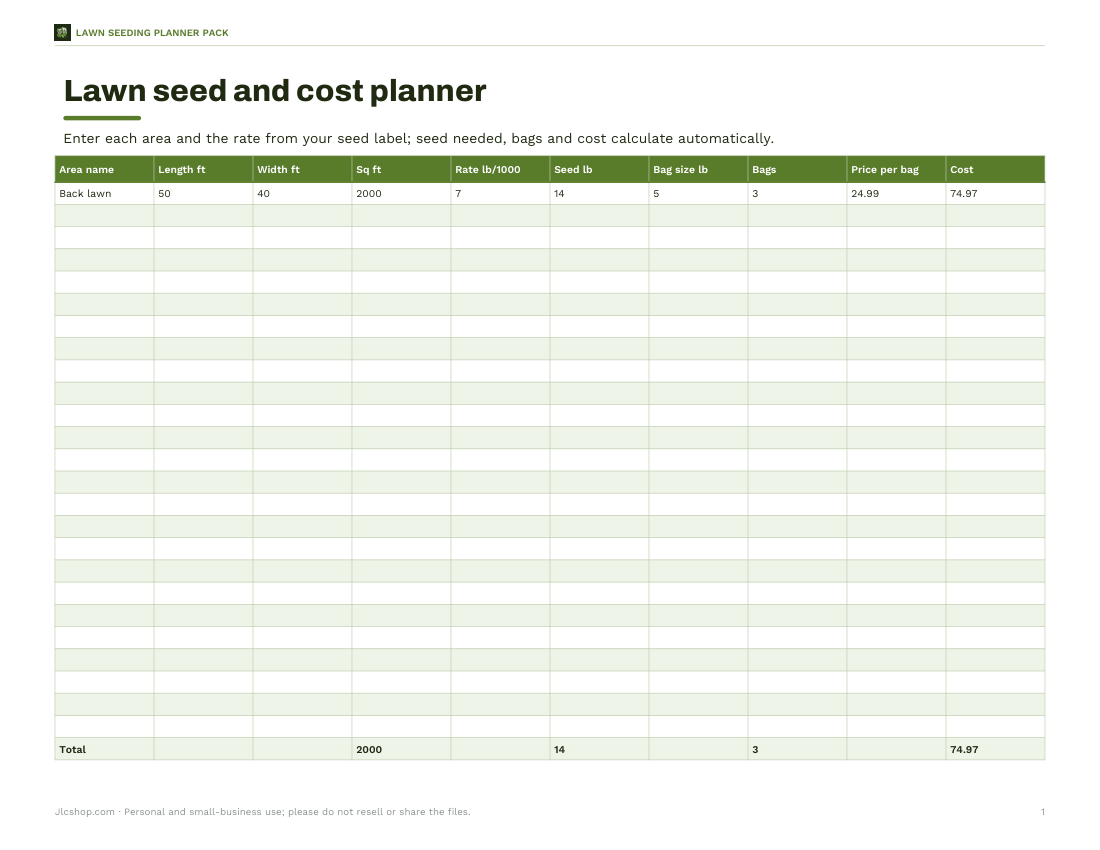
A 50 × 40 ft back lawn (2,000 sq ft) plus a 12 ft circular bed you are turning into lawn (about 113 sq ft) gives 2,113 sq ft. For a new tall fescue lawn at the middle of the 6–8 lb range (7 lb per 1,000 sq ft), you need about 14.8 lb of seed — three 5 lb bags. Overseeding the same area at 4 lb per 1,000 sq ft needs about 8.5 lb, so two 5 lb bags.
Cool-season vs warm-season grasses
Cool-season grasses — Kentucky bluegrass, fescues and ryegrass — grow best in spring and autumn and suit northern regions; sow them in late summer or early autumn when soil is warm and weeds are fewer. Warm-season grasses — bermuda, zoysia, centipede, bahia and buffalograss — thrive in heat and go dormant and brown in winter; sow them in late spring once soil is reliably warm. In transition zones, tall fescue is a common compromise.
How to seed a new lawn
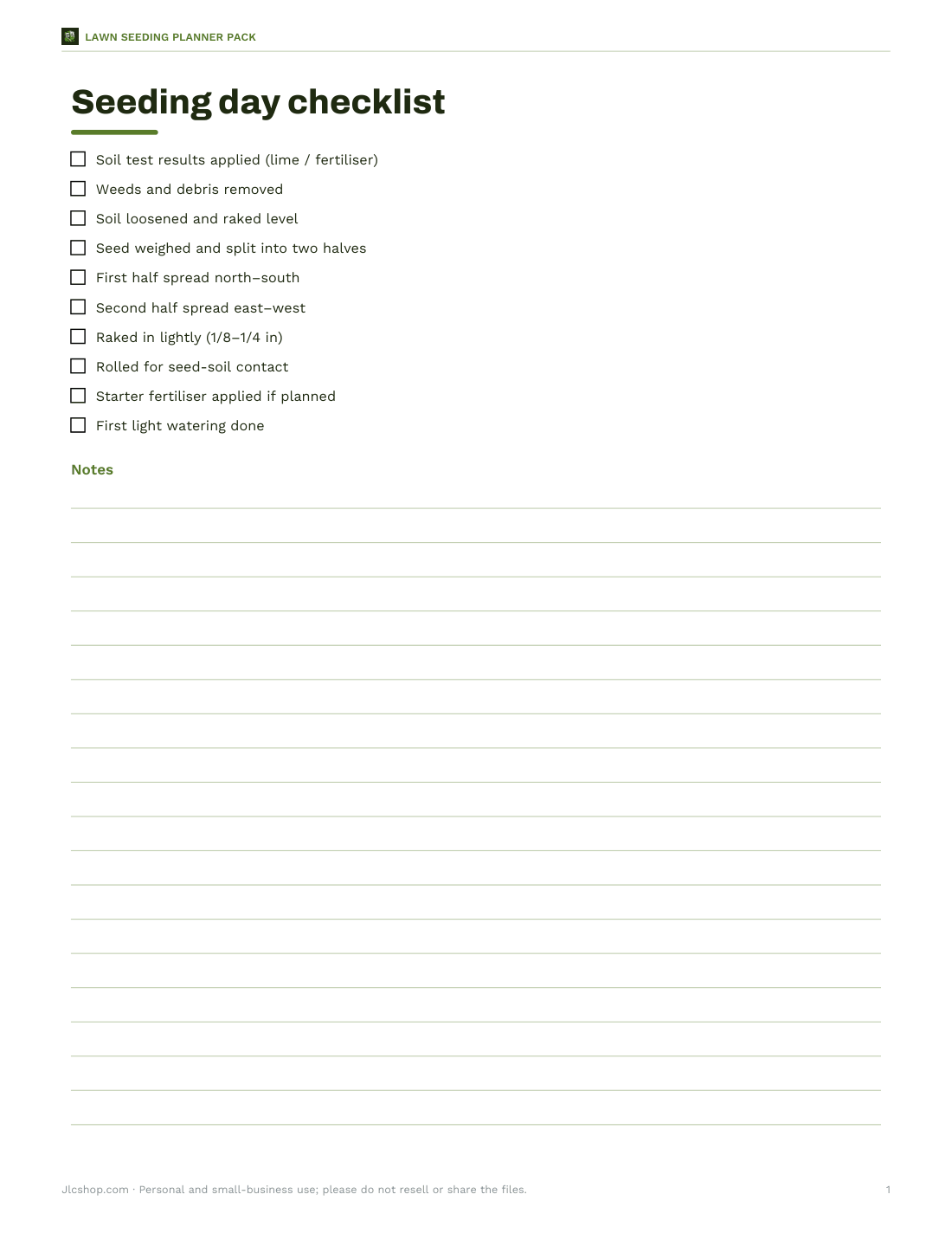
- Test the soil and add lime or fertiliser as recommended.
- Remove weeds and debris, loosen the top few inches and rake level.
- Split the seed in half and spread one half in one direction and the other half at right angles for even coverage.
- Rake lightly so seed is about 1/8 to 1/4 inch deep, then roll to firm contact.
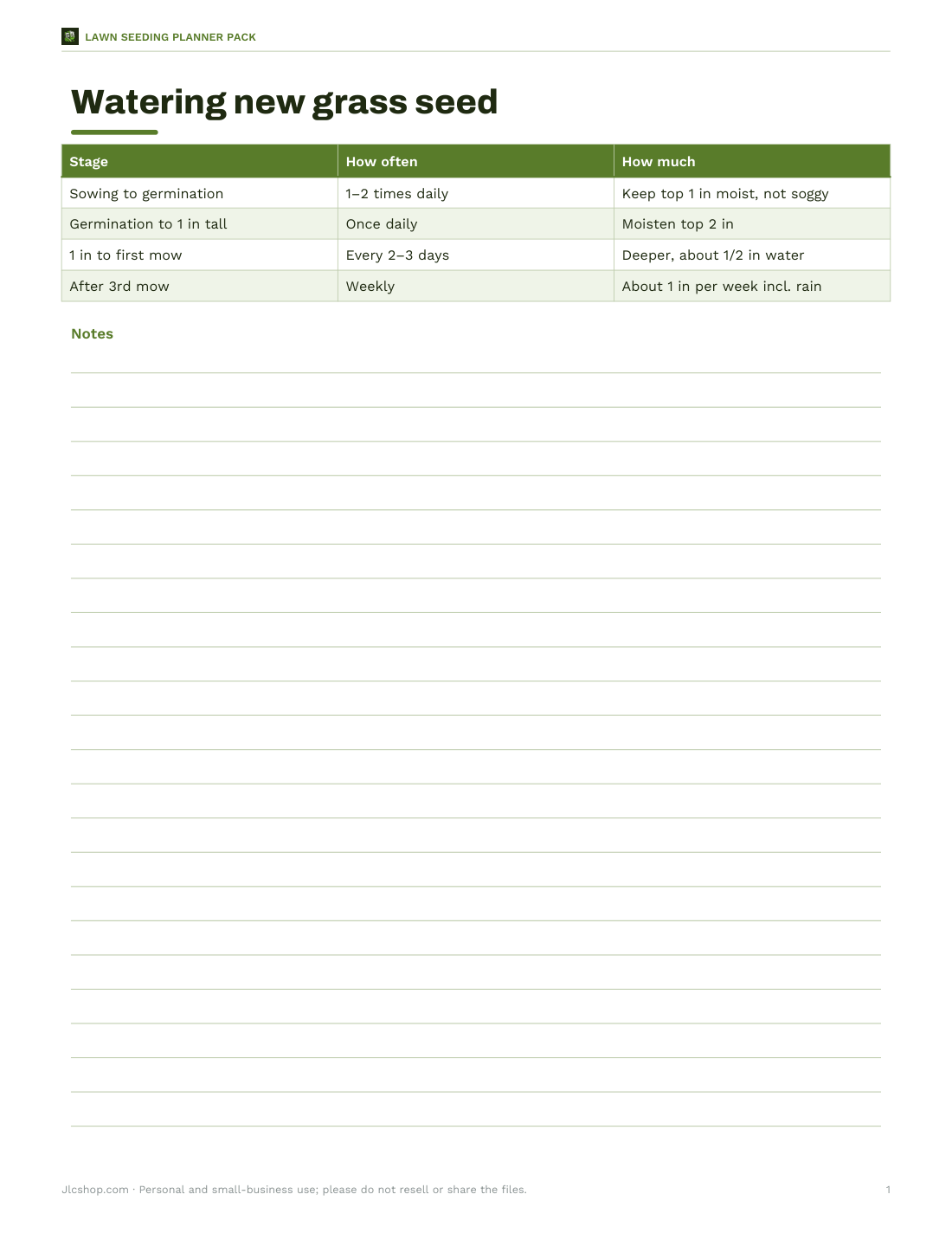
- Water lightly once or twice a day to keep the surface moist until germination.
- Mow for the first time when the grass is about a third taller than your target height.
Overseeding tips
- Mow the existing lawn short and remove clippings first.
- Dethatch or core-aerate so seed reaches the soil.
- Choose a variety that matches or improves on your existing grass.
- Keep the seed moist until new grass is established — usually 2–4 weeks.
- Avoid weedkillers before and after seeding unless the label says they are safe for new seed.
Seed quality and the label
Check the seed label before buying. It lists the species and varieties, the percentage of pure seed, the germination rate, the weed seed and “other crop” content, and the test date. Cheap mixes often contain a lot of annual ryegrass or inert matter, so you get less of the grass you want per pound. Coated seed is heavier because of the coating, which is why coated products have higher recommended rates.
Why not just use more seed?
Sowing well above the recommended rate doesn’t make a thicker lawn faster. Crowded seedlings compete for light, water and nutrients, grow thin and weak, and are more prone to disease. It is better to sow at the recommended rate, water correctly and overseed thin spots later.
The printable lawn seeding planner
The template pack includes an Excel lawn seed and cost planner for multiple areas, a seeding day checklist, a watering schedule for new seed, a cool- and warm-season lawn care calendar and a seed rate reference card — PDF, Word and Excel formats.
Frequently asked questions
How much grass seed do I need per 1,000 square feet?
It depends on the grass: about 2–3 lb for Kentucky bluegrass and 6–8 lb for tall fescue on a new lawn.
How much seed for overseeding?
Usually about half the new-lawn rate.
How much does a 5 lb bag of grass seed cover?
About 700–800 sq ft of new tall fescue lawn, or 2,000 sq ft of new Kentucky bluegrass.
Should I follow the rate on the seed bag?
Yes — enter it in the calculator; it overrides the typical range.
When is the best time to plant grass seed?
Early autumn for cool-season grasses, late spring for warm-season grasses.
How long does grass seed take to grow?
From about 5 days for ryegrass to 3–4 weeks for bluegrass or bahia.
Can I use this calculator for seed mixes?
Yes — enter the rate on the mix label for the most accurate result.